








The people behind your application
Arno vanKlinken
Senior Consultant
New machines, automation, robotics, more sustainable production: investment in manufacturing ties up capital that is missing elsewhere. At the same time, almost every modernisation project also contains a development share, which runs through different programmes than the plant investment itself. We assess both sides of your project, find the programmes that fit and handle the application through to the final report.



























Energy costs, the shortage of skilled staff and the shift to efficient, resource-conscious production usually arrive at the same time for our customers. Companies that invest now carry the risk alone at first, and modernising without a funding plan ties up more equity than necessary.
The real bottleneck is rarely the programme itself but the classification: which plant qualifies, which scheme fits, which deadline applies, and which share of the project is investment rather than development? We settle those questions before the investment starts.
Energy efficiency & decarbonisation
From equipment replacement to process heat: programmes for lower energy use and CO₂ are currently especially well funded.
Automation & robotics
Investment in robotics, sensor technology and connected equipment that secures productivity without replacing people.
Digitalisation & Industry 4.0
From the digital twin to connected manufacturing: funding for modernising production IT.
In manufacturing several instruments interlock. They cover different cost elements of your project. Which of them are realistically available for your specific project we establish before the application is written.
National and regional government subsidise investment in plant and sites. In Germany this runs above all through regional economic development such as GRW, complemented by state programmes. In the Netherlands the emphasis sits on tax-based instruments such as the EIA and MIA/Vamil.
Where you do not only procure but develop, for example a new production method or your own plant technology, development instruments apply. They fund the development share of your manufacturing projects, not the procurement itself.
In Germany this is the Forschungszulage, which works through tax and is settled with income or corporation tax. In the Netherlands the WBSO reduces the payroll tax you remit for staff on research and development, so it takes effect monthly.
The German ZIM programme has accepted no new applications since 7 July 2026, other than open international calls. Resumption is planned for early 2027.
The largest share of investment funding in manufacturing now goes to sustainability: energy-efficient plant, waste heat recovery, electrification of processes and resource-conscious methods. These projects run through their own programmes with their own deadlines and are frequently overlooked, because they are treated as an operational matter rather than a funding one.
For large or cross-border projects we open up European programmes. Horizon Europe carries the volume, while EUREKA Eurostars is in practice the more frequent route for smaller companies. Both demand precise applications against clear evaluation criteria and typically do not suit smaller modernisation projects.
We assess the whole landscape rather than one scheme, and we do it before the project starts. We also look at what has already been carried out and whether anything is still possible there.
STEP 1
Map.
We record completed, running and planned projects with their cost categories and timing.
STEP 2
Match.
We match each project to the right instrument and set which cost element runs through which. The same costs are not funded twice.
STEP 3
Apply.
We build the applications against the relevant evaluation criteria.
STEP 4
Secure.
After the award we support you through to a clean final report.
The people behind your application
Senior Consultant
The people behind your application
Consultant
The people behind your application
Medior Consultant
The people behind your application
Senior Consultant
The people behind your application
Senior Consultant

TSD Tooling & Precision
Tools that are accurate to within a thousandth of a millimetre: that calls for research, development and expensive prototypes. With the WBSO (the Dutch R&D tax credit) and Ignite Group’s technical knowledge, TSD…
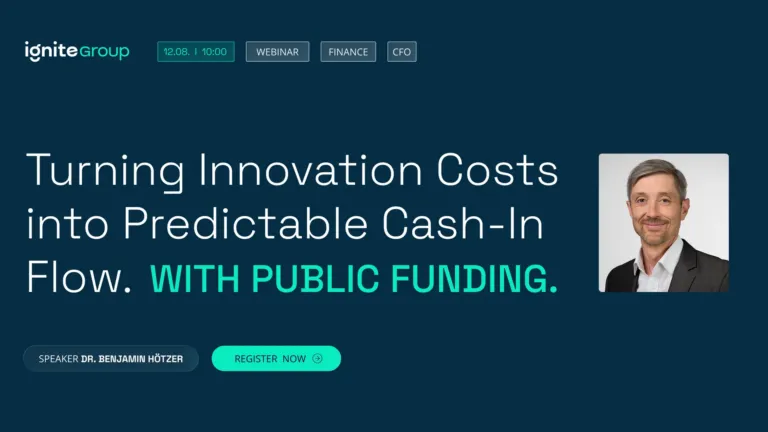
Turning Innovation into Predictable Cash Flow
How CFOs use public funding programmes as a strategic financial tool
Schuurman Schoenen
A family business with 650 employees, 49 stores and the conviction that the person behind the product is what counts. Together with Ignite Group, Schuurman Schoenen translated that vision into its own academy, more…


I only need to supply the necessary documents and Ignite Group takes care of the rest. It gives us the freedom to focus on developing our technology and selling our products.

Working with Ignite Group took a great deal of pressure off us. Thanks to […] their expertise, we always felt confident that our funding application was in the best hands.
Without the knowledge of ‘grant-speak’ and the speed of action, we would never have pulled this off.
Already know what this is about? Switch to the matching objective.
Find out what your business has been entitled to all along.