









The people behind your application
Hylke van derHeide
Senior Consultant
Energy prices, emissions targets, reporting duties, resource efficiency and new technologies change investment decisions faster than business models can carry them on market forces alone. That is exactly why public funding is directed into these areas. It exists to make investment, development and transformation possible where they are economically necessary but would otherwise happen too late or on too small a scale.
































Four developments drive investment decisions in this sector, across Europe alike.
Decarbonisation at pace. Emissions targets and carbon pricing pull forward investment in renewables, electrification and hydrogen, faster than the economics justify.
Energy security and cost. Volatile markets and the drive for independence have made clean generation and efficiency strategic priorities.
Grid, storage and flexibility. Integrating variable renewables strains grids and creates demand for storage and smart grid technology.
Circularity, water and environment. Circular models, waste valorisation and water technology are moving into core investment.
Renewable generation and heat
Solar, wind, geothermal and renewable heat, and the engineering of deploying them in demanding conditions.
Storage and grid innovation
Batteries and other storage, smart grid technology and integration of variable renewables where the engineering is genuinely new.
Hydrogen and carbon capture
Production, transport and use of hydrogen, and capture and use or storage of carbon, where technical and commercial risk is high.
Energy and resource efficiency
Re-engineering processes, buildings and systems to cut energy, emissions and resource use.
Circular economy and waste valorisation
Recycling and turning residual streams into usable materials or energy.
In energy and environmental projects, funding risk rarely comes from a lack of relevance. More often applications fail on timing, delimitation and evidence.
Investment funding generally has to be applied for before contracts are placed, equipment is ordered or construction work is commissioned. Looking for funding after the investment decision forfeits the claim under many programmes, even where the project would otherwise fit well.
A decarbonisation project can contain development work, capital investment and ongoing additional cost. These follow different funding logics. If costs are not separated cleanly, reductions or exclusions follow.
Energy and environmental programmes frequently assess concrete effects: CO2 reduction, energy savings, resource efficiency, circular content or environmental impact. These should be underpinned early with robust assumptions, baselines and a monitoring approach, so they remain traceable in the application and later in the reporting.
We do not start with the application but with the question of which parts of your project qualify and which funding logic they follow. Our specialists know the programmes and the evaluation practice in this sector.
STEP 1
Break the project down.
We separate development work, investment and ongoing additional cost.
STEP 2
Match the programmes.
We map each part to instruments at regional, national and European level.
STEP 3
Build the application.
We write against the actual evaluation criteria and underpin the impact with robust assumptions.
STEP 4
Protect what is awarded.
We keep documentation audit-ready throughout the funded period.
The people behind your application
Senior Consultant
The people behind your application
Senior Consultant

The people behind your application
Medior Consultant
The people behind your application
Consultant

The people behind your application
Medior Consultant

TSD Tooling & Precision
Tools that are accurate to within a thousandth of a millimetre: that calls for research, development and expensive prototypes. With the WBSO (the Dutch R&D tax credit) and Ignite Group’s technical knowledge, TSD…
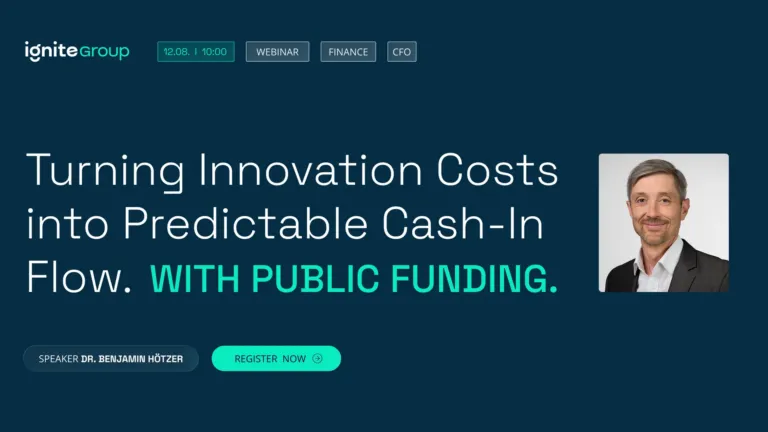
Turning Innovation into Predictable Cash Flow
How CFOs use public funding programmes as a strategic financial tool
Schuurman Schoenen
A family business with 650 employees, 49 stores and the conviction that the person behind the product is what counts. Together with Ignite Group, Schuurman Schoenen translated that vision into its own academy, more…


I only need to supply the necessary documents and Ignite Group takes care of the rest. It gives us the freedom to focus on developing our technology and selling our products.

Working with Ignite Group took a great deal of pressure off us. Thanks to […] their expertise, we always felt confident that our funding application was in the best hands.
Without the knowledge of ‘grant-speak’ and the speed of action, we would never have pulled this off.
Already know what this is about? Switch to the matching objective.
Find out what your business has been entitled to all along.