

LinkedInTwan de Laat
Senior Consultant
By Objective
By Industry
Success Story
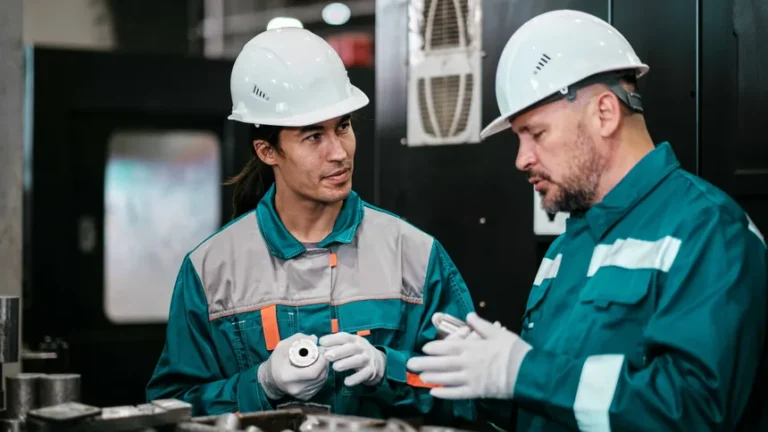
TSD Tooling & Precision. Making the difference down to the thousandth of a millimetre.
Read the case study: TSD Tooling & Precision. Making the difference down to the thousandth of a millimetre.
Popular programmes
From the Blog
Innovation Ecosystems and Public Funding: Why Structure Beats Network
Read the article: Innovation Ecosystems and Public Funding: Why Structure Beats Network
Technology & Quality
Success Story
Moekotte. Fifteen years of partnership, three funding schemes on.
Read the case study: Moekotte. Fifteen years of partnership, three funding schemes on.
Practice
Webinar
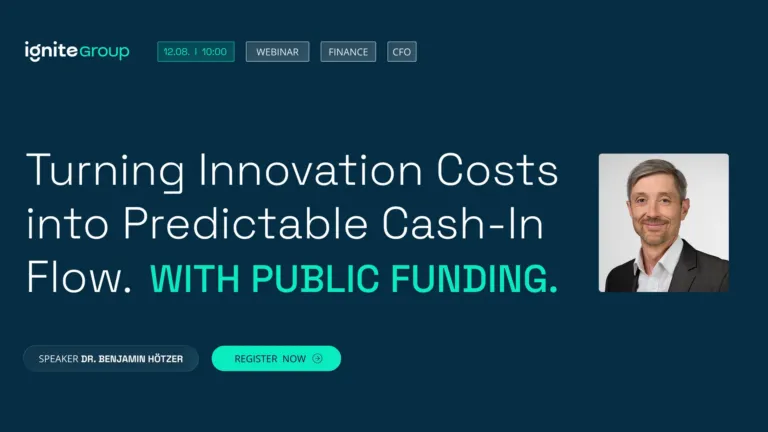
Turning Innovation into Predictable Cash-In Flow with Public Funding
Watch the webinar: Turning Innovation into Predictable Cash-In Flow with Public Funding
About Us
Network
News
Ignite Group strengthens expertise with acquisition of HGM Consultants
Learn more: Ignite Group strengthens expertise with acquisition of HGM Consultants
Choose your region
Read the case study
By Level
All programmes at a glance EU funding National funding Regional fundingPopular programmes
WBSO Innovationbox MIT grant VEKI MIA | Vamil EIA Horizon Europe EIC Accelerator
Read the article
How We Work
Our Process From Idea to Disbursement Engagement models Training and workshopsTechnology & Quality
AI and digital delivery Vindsubsidies.nl Grant Desks Grant Administration (SAS) SVS-UIT
Read the case study
Are you going to produce renewable energy or apply CO2-reducing techniques? In that case, you are eligible to apply for this grant. Here you can read more about the grant that has been made available for this purpose: the SDE++ grant scheme.
Budget
€ 8 billion
Deadline
26.11.2026
Location
National
SDE++ – key facts at a glance
Are you going to produce renewable energy or apply CO2-reducing techniques? In that case, you are eligible to apply for this grant. Here you can read more about the grant that has been made available for this purpose: the SDE++ grant scheme.
Target audience
Companies and non-profit institutions with large-scale projects
Public authorities with a renewable energy or CO2 reduction project
Producers of renewable electricity from solar and wind
Producers of renewable heat, biogas or green gas
Industry electrifying processes or capturing CO2
Requirements
A project realised in the Netherlands
All necessary permits, such as an environmental permit
A project that can be connected to the energy grid
Demonstrable financial feasibility of the project
Realisation within the maximum term per technology
Eligible costs
The difference between the cost price and the yield of the sustainable energy
Payment per tonne of CO2 avoided, rising in five phases to €400
Subsidy over a period of 12 or 15 years per technology
Production of renewable electricity, heat and green gas
CO2 capture, storage and use (CCS, CCU) and electrification
Are you going to produce renewable energy or apply CO2-reducing techniques? In that case, you are eligible to apply for this grant. Here you can read more about the grant that has been made available for this purpose: the SDE++ grant scheme.
SDE stands for Stimulation of Sustainable Energy Transition and Climate Transition. With the SDE++ subsidy, the government encourages the production of renewable energy and the application of CO2-reducing techniques in the Netherlands. The goal of this subsidy is to reduce CO2 emissions by 49% by 2030 compared to 1990 levels.
The SDE++ compensates the difference between the cost price of renewable energy or the reduced CO2 emissions and the (potential) revenues. The subsidy is granted over a period of 12 or 15 years, depending on the technology used. The amount of the subsidy depends on the technology applied and the CO2 reduction ultimately achieved. The maximum subsidy intensity you can claim with an SDE++ technique is 400 euros per ton of CO2 reduction. The subsidy application has five phases, with the maximum subsidy increasing per ton of avoided CO2. Therefore, it is crucial to submit your project at the right time. The maximum subsidy amounts to €75, €150, €225, €300, and €400 per ton of CO2 reduction, respectively.
Difference between SDE++ and ISDE:
The SDE++ (Stimulation of Sustainable Energy Production and Climate Transition) focuses on large-scale projects for companies and (non-profit) institutions that contribute to CO2 emission reduction, such as wind farms, solar energy, and bioenergy. If you, as a company (or individual), are engaged in smaller sustainable investments such as solar boilers and heat pumps, the ISDE (Investment Subsidy for Sustainable Energy) scheme may be applicable.
The SDE++ is the successor to the SDE+ and has a broader scope, encompassing not only sustainable energy production, but also technologies that contribute to CO2 reduction.
Projects falling within the following categories may be eligible for SDE++:
The specifications of these categories change regularly. This year, for example, several new categories were added, such as: solar PV with minor roof adjustments, nature-inclusive solar PV on fields, a generic category for aquathermy, air-water heat pump for application in horticulture, small-scale digestion, and finally, three new categories for electrification of the industry: thermal storage of high-temperature heat, process-integrated heat pump, and a category for hydrogen production through electrolysis based on a power purchase agreement (PPA).
Our experts are fully informed about all the current opportunities in the field of SDE grant, and can inform and advise you about them.
The conditions for applying for SDE++ grant can also vary greatly per grant round, and are periodically determined. Some general conditions that apply when applying for an SDE++ grant are:
The next opening for the Sustainable Energy Production and Climate Transition Incentive Scheme (SDE++) is from October 27th to November 26th, 2026.
Thanks to our 25 years of experience, we can optimize your grant process and take it almost completely off your hands.
What to think about in terms of work?
A funding advisor is an expert who guides companies through the complex process of applying for public funding and secures the best funding for their projects – from selecting the right programmes through the application to the final report.
At Ignite we work success-driven: we only make you an offer when we are convinced your project is eligible. You are supported comprehensively throughout the process while you concentrate on your core business – we take on the time-consuming part.
Our services as funding advisors

The advantages of our funding advisory

500Million
funding realized in 2025
95%
Success rate
15,000+
Funding applications in the last five years
300+
Funding and sector specialists
25+
Years of experience
11
Locations
A team of specialists at your service
LinkedInSenior Consultant
LinkedInMedior Consultant
LinkedInSenior Consultant
LinkedInMedior Consultant
LinkedInSenior Consultant
Usually yes. The eight sectors cover our focus areas, not the limits of the funding landscape. What matters is the purpose of your project, not the sector label.
It finds suitable programmes, assesses the chances, prepares applications and supports the reporting. At Ignite Group that starts with your objective rather than with a list of programmes.
Usually by whether the outcome is established at the outset. If the solution can be looked up and simply implemented, there is no eligible development. If it has to be tested, discarded and developed anew, there is.
Usually several apply. What matters is which one is the current bottleneck: capital for growth, development work without matching finance, too narrow an instrument mix, or uncertainty about evidence. We work that out in the first conversation.
Then several instruments frequently apply, for different projects. We map your whole project portfolio rather than pinning you to one sector.
At national level these include the WBSO, the MIT R&D scheme, the Innovatiebox, the MIT feasibility studies and the DHI scheme. European instruments such as EUREKA Eurostars are relevant too. Which ones fit your project is something we determine up front.
That depends on the project, the scale of funding and the model chosen. Our engagement models are explained on a dedicated page, so you know in advance which options exist.
Active in research and development, with development and production in the last 4 years? Get in touch now and benefit!